
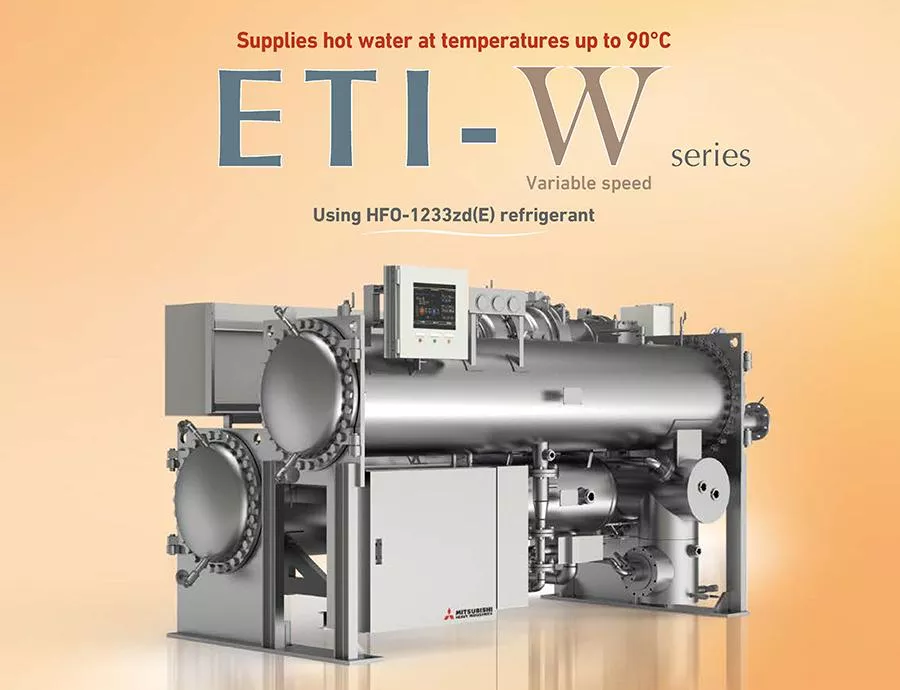
ETI-W Series Heat Recovery Type Water-to-Water Centrifugal Heat Pump
TOKYO, October 9, 2026 - (JCN Newswire) - Mitsubishi Heavy Industries Thermal Systems, Ltd. (MHI Thermal Systems), a part of Mitsubishi Heavy Industries (MHI) Group, is expanding the sales region to overseas markets beginning October 2026 for its "ETI-W" series heat recovery type centrifugal heat pump, launched in the Japanese market in 2025.(1) With demand for effective utilization of unused waste heat and decarbonization of heat utilization expanding worldwide, the addition of the ETI-W to the lineup of thermal solutions for overseas markets will allow MHI Thermal Systems to further broaden its support for high-temperature water applications.
ETI-W is a heat recovery type centrifugal heat pump that captures low-temperature waste heat (heat source water) generated during factory production processes, and by utilizing the thermodynamic principle of a heat pump, reuses it as hot water up to 90'C. With a maximum heating capacity of 640kW, the ETI-W can effectively exploit previously underutilized waste heat to produce high-temperature water. This expands the application range of heat pumps to high-temperature water applications, which have conventionally been handled by boilers and similar equipment.
As in Japan, MHI Thermal Systems will focus its overseas business expansion for ETI-W on process applications in electronics, automotive, food, chemical, and pharmaceutical factories, as well as heating and hot water supply for commercial and accommodation facilities. In terms of sales and service, the company will leverage its overseas sales and service network established in the centrifugal water chiller business to market and service ETI-W in each region. MHI Thermal Systems will offer optimal thermal solutions, including the recovery and reuse of unused heat utilizing ETI-W, according to the specific circumstances for each customer, such as the temperature amount of heat available from the waste heat source, and the required hot water temperature.
In facilities equipped with chiller, it is also possible to configure systems that use ETI-W to recover the heat retained by the chiller's cooling water, and reuse it as high-temperature water. This allows the waste heat generated from cooling equipment to be effectively utilized for thermal demand, leading to improved energy utilization efficiency. For facilities such as data centers which continuously generate waste heat from cooling equipment, under suitable conditions such as the temperature and amount of waste heat, ETI-W can be used as a heat source to meet demand for heating and hot water supply.
ETI-W utilizes centrifugal compressor technology developed by MHI Thermal Systems over many years for centrifugal chillers. By designing compressors suited to the refrigerant properties and the high compression ratios (the ratio of the compressor's discharge pressure to suction pressure) associated with high-temperature water supply, MHI Thermal Systems has achieved a COP(2) of 4.01 during heating, even when supplying hot water up to 90'C. Additionally, the incorporation of an internal inverter, and optimization of the heat exchanger design, allows for both high heating capacity and a compact package. For greater environmental performance, the unit utilizes the low-GWP(3) refrigerant HFO-1233zd(E).
MHI Group is taking measures to reduce production-related CO2 emissions from its own plants and facilities, as well as reduce the CO2 emissions of its customers associated with the use of MHI Group products. MHI Thermal Systems, a member of the corporate group, supplies many centrifugal chillers for general air conditioning, factory air conditioning, and district heating and cooling. Going forward, through products and technologies such as centrifugal chillers and heat pumps, MHI Thermal Systems will continue to provide thermal solutions to meet the diverse heat needs of customers, and contribute to the realization of a carbon-neutral world.
(1) For details on the launch of ETI-W in the Japanese market, see the following press release.https://www.mhi.com/news/25100302.html
(2) Coefficient of performance (COP) is a performance coefficient calculated based on Japanese Industrial Standards (JIS). Higher values indicate greater energy efficiency.
(3) Global Warming Potential (GWP) is a coefficient of the greenhouse effect of a gas relative to carbon dioxide (CO2), which has a fixed GWP of 1.0. Smaller values indicate better environmental performance.
About MHI Group
Mitsubishi Heavy Industries (MHI) Group is one of the world's leading industrial groups, spanning energy, smart infrastructure, industrial machinery, aerospace and defense. MHI Group combines cutting-edge technology with deep experience to deliver innovative, integrated solutions that help to realize a carbon neutral world, improve the quality of life and ensure a safer world. For more information, please visit www.mhi.com or follow our insights and stories on spectra.mhi.com.
Copyright 2026 JCN Newswire. All rights reserved. www.jcnnewswire.com